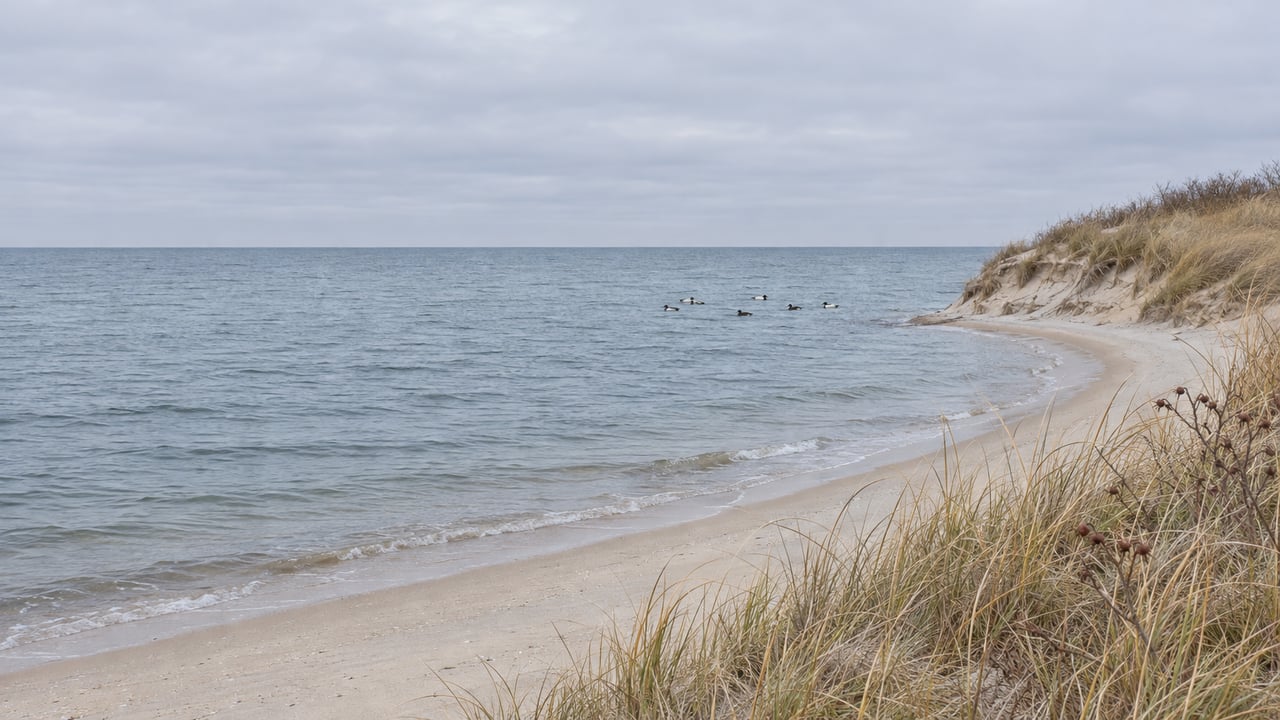
On December 28, 2025, 81 people counted birds across Nantucket in the snow, and the 28,730 eiders they tallied set no record. The new records were hawks, woodpeckers and ravens, all counted on land. A good share of that land is backyards, trails and conservation properties that people walk past all winter.
The Linda Loring Nature Foundation at 110 Eel Point Road organizes the island's Christmas Bird Count. The 72nd count is set for Sunday, January 3, 2027. Nantucket has taken part since 1954. The first count had 3 volunteers, and the island now draws more than 70 local and off-island birders. Registration closes December 18, and last winter's results suggest where an extra volunteer counts the most.
Half the Birds Came From the Water
The final compilation for the 71st count, held December 28, 2025, lists 133 species and 61,727 individual birds. Common Eiders account for 28,730 of those birds, about 46 percent of everything counted that day.
The year before tells you what drives the total. The 70th count on December 29, 2024, recorded 138 species and 40,763 birds. That means the island counted five fewer species in 2025 but about 21,000 more birds. Eiders alone grew by about 13,500 between the two counts, from 15,261 to 28,730. The other big jump came from Red-throated Loons, which went from 71 to 4,269. Of those, 4,225 were counted in the Low Beach section.
| Count | Species | Individual birds | Common Eider | Red-throated Loon | Long-tailed Duck |
|---|---|---|---|---|---|
| 70th, Dec. 29, 2024 | 138 | 40,763 | 15,261 | 71 | 1,556 |
| 71st, Dec. 28, 2025 | 133 | 61,727 | 28,730 | 4,269 | 4,842 |
The volume shows up on the map too. On count day the island is split into eight sections: Great Point, Low Beach, Quidnet, Quaise, Town, Surfside, Bartlett's and Madaket. In 2025, the Great Point and Low Beach sections counted 16,068 and 17,026 birds. Together that's more than half the island's total. A year earlier, the same two sections counted 2,125 and 5,073. Great Point produced 12,169 eiders by itself. A raft offshore can swing the island's total by thousands of birds in a single year, depending on where it sits on count day.
The Records Came From Land
Libby Buck of LLNF wrote up last winter's results, first published in Nantucket Current. Her list of new record highs had no sea ducks on it. It was Cooper's Hawks, Yellow-bellied Sapsuckers and Common Ravens. The final compilation counts 26 Cooper's Hawks spread across six of the eight sections, plus 14 sapsuckers and 9 ravens.
Most of the unusual birds Buck named were land birds too. A Sandhill Crane had been on the island for much of the year and turned up on count day. Volunteers also logged a Lincoln's Sparrow, a Clay-colored Sparrow, an American Pipit, four Evening Grosbeaks, five Tree Swallows and a single Eastern Bluebird. Out on the water there were two Black Guillemots and a Kamchatka Common Gull. Twenty-four Harlequin Ducks were all counted in the Low Beach and Quidnet sections.
The section totals tell the same story from another angle. Madaket logged 94 species, the most of any section, while counting only 2,963 birds. Great Point counted more than five times as many birds and found 55 species. A few strong telescopes can cover the rafts offshore. Finding the variety takes many people in many places, including backyards.
Twenty Kitchen Windows, a Record of Their Own
This is where the count leans on people who live here. Buck reported that 81 volunteers took part in the 71st count, a new record. They included a record 20 feeder-watchers, on a day she described as snowy and bitterly cold, with frozen ponds and snow-covered trails. Teams finished the day at the compilation meeting at the UMass Boston Nantucket Field Station and shared their highlights and totals.
LLNF offers three ways to take part, and only one of them asks for a full day in the field:
- Feeder Watcher. If you have a feeder in your yard, you keep track of the birds that visit it during the 24-hour count. LLNF says everyone is welcome to do this.
- Field Observer for one property. If you already walk a favorite conservation property, you can cover it on count day and report what you find.
- Section field observer. If you can give the whole day, you're assigned to one of the eight sections with a team leader.
Feeder Watchers use a data form from LLNF and email it to [email protected] by the end of count day.
What the West End Holds in Winter
Within a few minutes of the foundation's Eel Point Road office, the shoreline and ponds already have a winter birding record. A Bird Observer overview of New England island birding names Eel Point as a place to watch early-morning winter flights of Long-tailed Ducks. Last winter's count logged 4,842 of them, up from 1,556 the year before.
Capaum Pond has its own history. In January 2025, The Inquirer and Mirror reported an American Bittern there in winter, along with nine Northern Shovelers on the pond. In a winter piece on the LLNF blog, the foundation describes ducks gathering on whatever open water is left in ponds and tidal areas, and sea ducks rafting offshore in Nantucket Sound.
Last year's numbers show that more volunteers in more places means more species found. If you walk the same stretch of shoreline every week, you already know where the open water is when the ponds freeze. That's the kind of knowledge the Field Observer role is built for.
The Calendar From Here
The dates, as LLNF lists them:
- Thursday, December 17, 5pm. A Zoom information and Q&A session for new volunteers. Sign up through the link on LLNF's count page.
- Friday, December 18, 2026. Volunteer registration closes.
- Thursday, December 31, through Wednesday, January 6. Count Week covers the three days before and the three days after Count Day. Birds missed on the day itself but seen during Count Week still go on the final list.
- Sunday, January 3, 2027. Count Day, a 24-hour tally across all eight sections, followed by the compilation meeting at 6PM at the UMass Nantucket Field Station.
Count Week is also a way in for people who can't give the day itself. After last year's count, LLNF asked people to watch for birds inside the official count circle during that window. It explained that Count Week species don't go into the count-day totals but do appear in the final report.
For questions, LLNF lists [email protected], or you can call Libby Buck at the foundation at (508) 325-0873.
We'll be watching the January 3 tally from our own windows this year, and we'd love to hear what turns up at yours. If a winter of sea ducks off Eel Point has you thinking about a place on the island, or a week here next summer, Sanford & Sanford can help you buy, sell or rent on Nantucket.